|
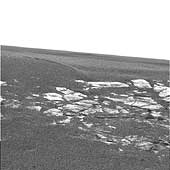
Opportunity Sits In A Small Crater, Near A Bigger One(January 26, 2004)A small impact crater on Mars is the new home for NASA's Opportunity rover, and a larger crater lies nearby. Scientists value such crater locations as a way to see what's beneath the surface without needing to dig. Encouraging developments continued for Opportunity's twin, Spirit, too. Engineers have determined that Spirit's flash memory hardware is functional, strengthening a theory that Spirit's main problem is in software that controls file management of the memory. "I think we've got a patient that's well on the way to recovery," said Mars Exploration Rover Project Manager Pete Theisinger at NASA's Jet Propulsion Laboratory, Pasadena, Calif. Opportunity returned the first pictures of its landing site early today, about four hours after reaching Mars. The pictures indicate that the spacecraft sits in a shallow crater about 20 meters (66 feet) across. "We have scored a 300-million mile interplanetary hole in one," said Dr. Steve Squyres of Cornell University, Ithaca, N.Y., principal investigator for the science instruments on both rovers. NASA selected Opportunity's general landing area within a region called Meridiani Planum because of extensive deposits of a mineral called crystalline hematite, which usually forms in the presence of liquid water. Scientists had hoped for a specific landing site where they could examine both the surface layer that's rich in hematite and an underlying geological feature of light -colored layered rock. The small crater appears to have exposures of both, with soil that could be the hematite unit and an exposed outcropping of the lighter rock layer. "If it got any better, I couldn't stand it," said Dr. Doug Ming, rover science team member from NASA Johnson Space Center, Houston. With the instruments on the rover and just the rocks and soil within the small crater, Opportunity should be allow scientists to determine which of several theories about the region's past environment is right, he said. Those theories include that the hematite may have formed in a long-lasting lake or in a volcanic environment. An even bigger crater, which could provide access to deeper layers for more clues to the past, lies nearby. Images taken by a camera on the bottom of the lander during Opportunity's final descent show a crater about 150 meters (about 500 feet) across likely to be within about one kilometer or half mile of the landing site, said Dr. Andrew Johnson of JPL. He is an engineer for the descent imaging system that calculated the spacecraft's horizontal motion during its final seconds of flight. The system determined that sideways motion was small, so Opportunity's computer decided not to fire the lateral rockets carried specifically for slowing that motion. Squyres presented an outline for Opportunity's potential activities in coming weeks and months. After driving off the lander, the rover will first examine the soil right next to the lander, then drive to the outcrop of layered -looking rocks and spend considerable time examining it. Then the rover may climb out of the small crater, take a look around, and head for the bigger crater. But first, Opportunity will spend more than a week -- perhaps two -- getting ready to drive off the lander, if all goes well. Engineering data from Opportunity returned in relays via NASA's Mars Odyssey orbiter early this morning and at midday indicate the spacecraft is in excellent health, said JPL's Arthur Amador, mission manager. The rover will try its first direct-to-Earth communications this evening. The main task for both rovers in coming months is to explore the areas around their landing sites for evidence in rocks and soils about whether those areas ever had environments that were watery and possibly suitable for sustaining life. |