|
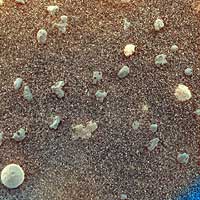
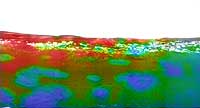
Opportunity Sees Tiny Spheres In Martian Soil(February 04, 2004)NASA's Opportunity has examined its first patch of soil in the small crater where the rover landed on Mars and found strikingly spherical pebbles among the mix of particles there. "There are features in this soil unlike anything ever seen on Mars before," said Dr. Steve Squyres of Cornell University, Ithaca, N.Y., principal investigator for the science instruments on the two Mars Exploration Rovers. For better understanding of the soil, mission controllers at NASA's Jet Propulsion Laboratory, Pasadena, Calif., plan to use Opportunity's wheels later this week to scoop a trench to expose deeper material. One front wheel will rotate to dig the hole while the other five wheels hold still. The spherical particles appear in new pictures from Opportunity's microscopic imager, the last of 20 cameras to be used on the two rover missions. Other particles in the image have jagged shapes. "The variety of shapes and colors indicates we're having particles brought in from a variety of sources," said Dr. Ken Herkenhoff of the U.S. Geological Survey's Astrogeology Team, Flagstaff, Ariz. The shapes by themselves don't reveal the particles' origin with certainty. "A number of straightforward geological processes can yield round shapes," said Dr. Hap McSween, a rover science team member from the University of Tennessee, Knoxville. They include accretion under water, but apparent pores in the particles make alternative possibilitie s of meteor impacts or volcanic eruptions more likely origins, he said. A new mineral map of Opportunity's surroundings, the first ever done from the surface of another planet, shows that concentrations of coarse-grained hematite vary in different parts of the crater. The soil patch in the new microscopic images is in an area low in hematite. The map shows higher hematite concentrations inside the crater in a layer above an outcrop of bedrock and on the slope just under the outcrop. Hematite usually forms in association with liquid water, so it holds special interest for the scientists trying to determine whether the rover landing sites ever had watery environments possibly suitable for sustaining life. The map uses data from Opportunity's miniature thermal emission spectrometer, which identifies rock types from a distance. "We're seeing little bits and pieces of this mystery, but we haven't pieced all the clues together yet," Squyres said. Opportunity's Mössbauer spectrometer, an instrument on the rover's robotic arm designed to identify the types of iron-bearing minerals in a target, found a strong signal in the soil patch for olivine. Olivine is a common ingredient in volcanic rocks. A few days of analysis may be needed to discern whether any fainter signals are from hematite, said Dr. Franz Renz, science team member from the University of Mainz, Germany. To get a better look at the hematite closer to the outcrop, Opportunity will go there. It will begin by driving about 3 meters (10 feet) tomorrow, taking it about halfway to the outcrop. On Friday it will dig a trench with one of its front wheels, said JPL's Dr. Mark Adler, mission manager. Opportunity's twin, Spirit, today is reformatting its flash memory, a preventive measure that had been planned for earlier in the week. "We spent the last four days in the testbed testing this," Adler said. "It's not an operation we do lightly. We've got to be sure it works right." Tomorrow, Spirit will resume examining a rock called Adirondack after a two-week interruption by computer memory problems. Controllers plan to tell Spirit to brush dust off of a rock and examine the cleaned surface tomorrow. Each martian day, or "sol," lasts about 40 minutes longer than an Earth day. Spirit begins its 33rd sol on Mars at 2:43 a.m. Thursday, Pacific Standard Time. Opportunity begins its 13th sol on Mars at 3:04 p.m. Thursday, PST. |