|
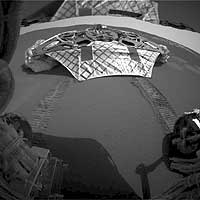
Opportunity Rolls Onto Martian Ground(January 31, 2004)NASA's Mars Exploration Rover Opportunity drove down a reinforced fabric ramp at the front of its lander platform and onto the soil of Mars' Meridiani Planum this morning. Also, new science results from the rover indicate that the site does indeed have a type of mineral, crystalline hematite, that was the principal reason the site was selected for exploration. Controllers at NASA's Jet Propulsion Laboratory received confirmation of the successful drive at 3:01 a.m. Pacific Standard Time via a relay from the Mars Odyssey orbiter and Earth reception by the Deep Space Network. Cheers erupted a minute later when Opportunity sent a picture looking back at the now-empty lander and showing wheel tracks in the martian soil. For the first time in history, two mobile robots are exploring the surface of another planet at the same time. Opportunity's twin, Spirit, started making wheel tracks halfway around Mars from Meridiani on Jan. 15. "We're two for two! One dozen wheels on the soil." JPL's Chris Lewicki, flight director, announced to the control room. Matt Wallace, mission manager at JPL, told a subsequent news briefing, "We knew it was going to be a good day. The rover woke up fit and healthy to Bruce Springsteen's 'Born to Run,' and it turned out to be a good choice." The flight team needed only seven days since Opportunity's landing to get the rover off its lander, compared with 12 days for Spirit earlier this month. "We're getting practice at it," said JPL's Joel Krajewski, activity lead for the procedure. Also, the configuration of the deflated airbags and lander presented no trouble for Opportunity, while some of the extra time needed for Spirit was due to airbags at the front of the lander presenting a potential obstacle. Looking at a photo from Opportunity showing wheel tracks between the empty lander and the rear of the rover about one meter or three feet away, JPL's Kevin Burke, lead mechanical engineer for getting the rover off the lander, said "We're glad to be seeing soil behind our rover." JPL's Chris Salvo, flight director, reported that Opportunity will be preparing over the next couple days to reach out with it robotic arm for a close inspection of the soil. Gray granules covering most of the crater floor surrounding Opportunity contain hematite, said Dr. Phil Christensen, lead scientist for both rovers' miniature thermal emission spectrometers, which are infrared-sensing instruments used for identifying rock types from a distance. Crystalline hematite is of special interest because, on Earth, it usually forms under wet environmental conditions. The main task for both Mars Exploration Rovers in coming weeks and months is to read clues in the rocks and soil to learn about past environmental conditions at their landing sites, particularly about whether the areas were ever watery and possibly suitable for sustaining life. The concentration of hematite appears strongest in a layer of dark material above a light-covered outcrop in the wall of the crater where Opportunity sits, Christensen said. "As we get out of the bowl we're in, I think we'll get onto a surface that is rich in hematite," he said. |