|
COMETS EARTH JUPITER KUIPER BELT MARS MERCURY METEORITES NEPTUNE OORT CLOUD PLUTO SATURN SOLAR SYSTEM SPACE SUN URANUS VENUS ORDER PRINTS
PHOTO CATEGORIES SCIENCEVIEWS AMERICAN INDIAN AMPHIBIANS BIRDS BUGS FINE ART FOSSILS THE ISLANDS HISTORICAL PHOTOS MAMMALS OTHER PARKS PLANTS RELIGIOUS REPTILES SCIENCEVIEWS PRINTS
|
 |
Related Document
Download Options
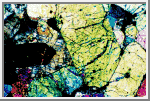
Rocks are often made of small mineral grains that can't be seen clearly without a microscope. To see these small grains, scientists grind and polish rock samples very thin (0.03 millimeters) so light can pass through them. This microscopic view, 2.3 millimeters (.09 inches) across, is in false color, produced by holding polarizing filters above and below the microscopic slide. These filters cause different minerals to have distinctive colors, allowing easy identification of the minerals. Most of this meteorite (in yellow, green, pink, and black) is the mineral olivine, which is common in some basaltic rocks. The striped grain near the center is the mineral pyroxene. (Courtesy Allan Treiman, LPI) |